

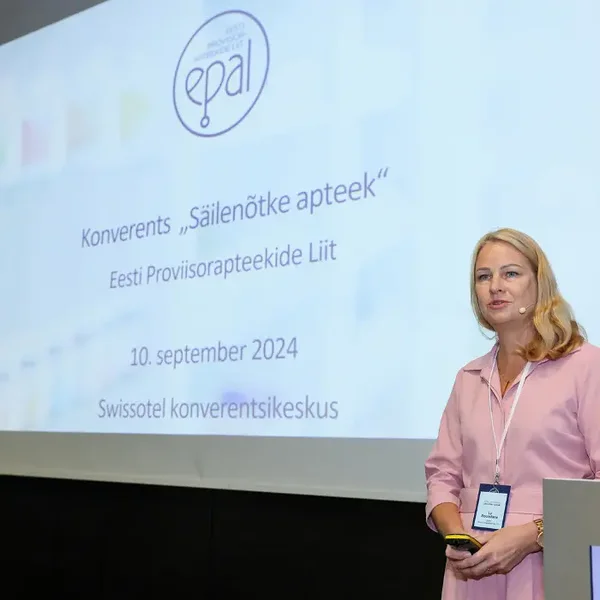
On September 10, the annual autumn conference, organized by our largest organization uniting pharmacists, the Estonian Association of Pharmacists' Pharmacies (EPAL), took place in Tallinn. This year’s theme was the resilience of pharmacies in a rapidly changing environment, with the main topic being the evolving role and importance of pharmacies in Estonian healthcare. Below are brief summaries of the presentations.
EPAL's leader, Ly Rootslane, highlighted the main theme of the conference in her opening presentation: how pharmacists and Estonian healthcare are rethinking the role of pharmacies in a changing world. According to Rootslane, it is inevitable that pharmacists' responsibilities will expand, as Estonian healthcare can no longer cope with its existing resources. A crucial component of this expansion is patient counseling, as the pharmacy is the most accessible part of the healthcare system. Pharmacists guide people in making the right health choices, helping to reduce healthcare costs and ease the growing burden on doctors.
Anniki Lai, Deputy Secretary General for Health at the Ministry of Social Affairs, painted a broader picture of where Estonian healthcare is headed in a situation where the population is aging and shrinking, and no significant investments or additional funding are expected for the sector in the near future. According to Lai, the system is facing tough years ahead, and pharmacies will play a key role, particularly in coverage, as we live in a complex geopolitical situation. The deputy secretary provided an overview of new strategies and development plans under the ministry's consideration.
Chairperson of the Estonian Society of General Practitioners, Elle-Mall Sadrak, discussed how pharmacists and doctors can work together more effectively. According to Sadrak, it is vital for a family doctor to have a good pharmacist in their area to consult with and refer patients to. She emphasized that family doctors would like their patients to visit a pharmacist first for simpler health issues, such as colds or the use of over-the-counter medications. This requires patient awareness and readiness for the system to function this way.
Annika Veimer, Director of the National Institute for Health Development, pointed out that nearly 40% of all deaths in Estonia are linked to modifiable risk behaviors—dietary risks, tobacco, alcohol, and lack of physical activity. Obesity alone leads to 250,000 illness cases and 650 deaths annually. Every second adult in Estonia is overweight or obese, and three-quarters of adults are physically inactive. Estonia ranks first among OECD countries for regular e-cigarette use. One-third of Estonians have tried drugs, and 113 people in Estonia died from overdoses last year. Veimer believes that pharmacists have significant potential to assist people by offering vaccination, counseling, health testing, screening, and raising health awareness close to home.
Liivi Maddison, head of a department at North Estonia Medical Center, discussed the effects of the green transition on healthcare using PERH (North Estonia Medical Center) as an example. Direct environmental pollution comes from the hospital's fleet, buildings, anesthetic gases, and coolants. One way to reduce this is by increasing remote consultations via video calls and teleconferencing. While environmentally-friendly building projects could help, there are currently no resources for such investments. Maddison also discussed indirect emissions, including everything purchased by the hospital. Waste handling of medications is crucial. Gloves are a significant expense, and currently, there are no recycling options—PERH alone uses over 35,000 pairs of gloves daily.
Priit Saar, Deputy Director of Coordination at the Government Office, outlined patterns of health behavior during crises. While the direct risk of war in Estonia remains low, we must still be prepared to defend the country against attacks. Power and communication disruptions are serious threats, with risks also posed to critical infrastructure. The country must be prepared for mass migration, transport accidents, environmental pollution, disease outbreaks, and cyberattacks. According to Saar, pharmacists can help by being aware of the country's general risk landscape and ensuring the availability of medications.
Luis Miguel Lourenco, Professional Secretary and Community Pharmacist at the International Pharmaceutical Federation (FIP), presented interesting statistics on the role of pharmacies worldwide during the COVID-19 pandemic. In 2022, pharmacies in 48 countries administered COVID-19 vaccinations, playing a pivotal role: in France, over half of the vaccinations were done in pharmacies, in the United States it was 44%, and in the UK almost a quarter. Globally, one-quarter of flu vaccinations are now done in pharmacies, highlighting their central role in healthcare.
Health Minister Riina Sikkut also addressed the participants, emphasizing the importance of unity among health sector stakeholders to implement reforms, from access to health portals to vaccinations and professional medication counseling in pharmacies. The minister urged pharmacists to be active in information exchange and discussions on key issues.
The conference concluded with a panel discussion, featuring Katrin Kaarna, Head of the Clinical Trials Center at the University of Tartu, Maia Uusküla, Head of the Drug Safety Department at the Medicines Agency, Izabelle Adamson, Head of the Tallinn Pharmacy on Ravi Street, Anu Randmaa, Regional Manager of Südameapteek, and Lille Priks, Pharmacist at Lasnamäe Health Center Pharmacy. The panel discussed how to better and more thoroughly counsel people in pharmacies. Medications often have side effects and/or interactions, which can be numerous, but it is crucial to identify the right and important ones for each individual.
For more information: Ly Rootslane, EPAL Leader / ly.rootslane@epal.ee
EPAL Press Release
